The 7th International Scientific Conference of the Faculty of Journalism and Mass Communication focuses on trust, authenticity and the media in the platform society
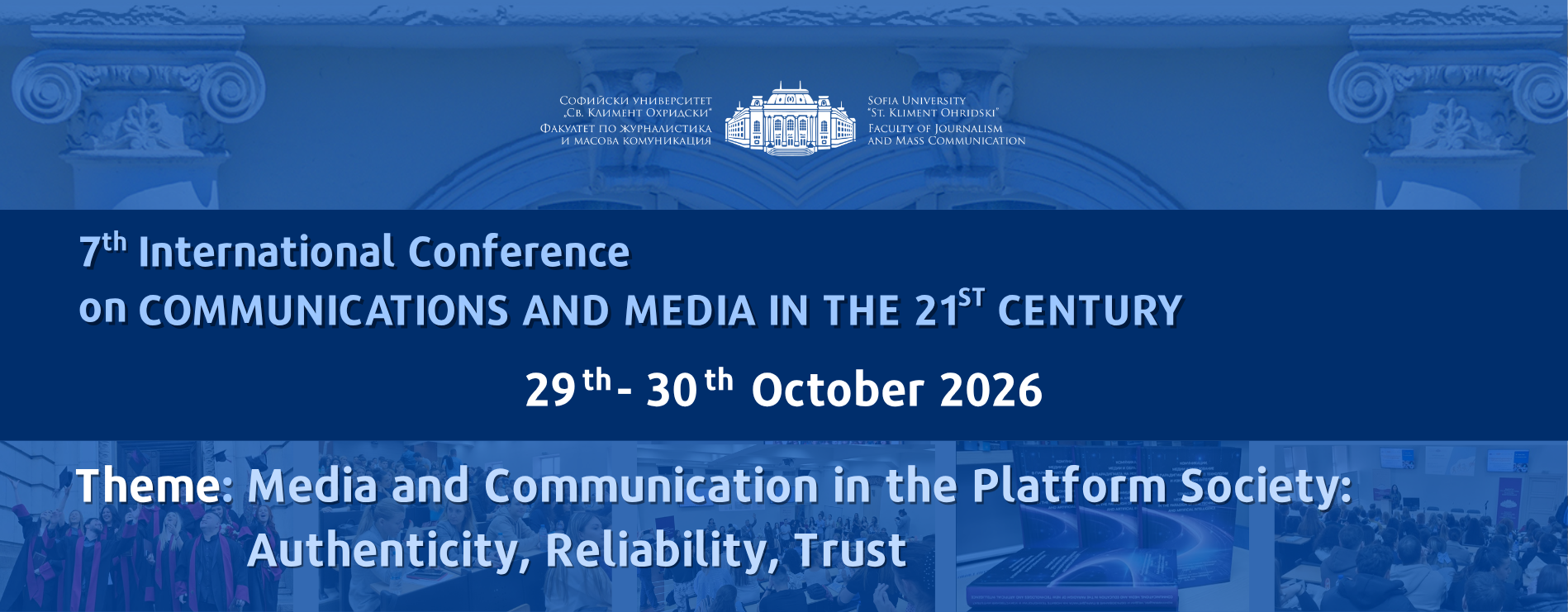
On October 29 and 30, 2026, the Faculty of Journalism and Mass Communication at Sofia University “St. Kliment Ohridski” will host the Seventh International Scientific Conference in the series “Communication and Media in the 21st Century.” This year’s edition is titled “Media and Communication in the Platform Society: Authenticity, Reliability, Trust” and will bring together researchers from Bulgaria and ten other countries for a two-day online academic forum.
The seventh edition continues the FJMC’s established tradition of creating a space for international academic exchange on current issues in journalism, media, and communication. The conference is organized jointly with academic partners from Eastern Kentucky University, USA, Vilnius University and Vytautas Magnus University in Lithuania, the Polytechnic Institute of Lisbon in Portugal, Shota Rustaveli State University in Batumi, Georgia, and the University of Bucharest in Romania.
The two-day program focuses on some of the most pressing issues facing contemporary media and public communication—the impact of platformization and artificial intelligence on journalistic and communication practices, shifts in public trust, new dimensions of authenticity and credibility, the role of algorithms in public communication, the spread of disinformation, and changes in the relationships between media, institutions, organizations, and audiences.
The conference will be opened on October 29 at 10:00 a.m. by the dean of the Faculty of Journalism and Mass Communication, Prof. Dr. Veselina Valkanova. Following the official opening, a plenary session in English will take place, marking the start of the academic discussions. During the afternoon program on the first day, participants will work in four thematic panels: “AI, Algorithms & Digital Media Transformation,” “Journalism, Verification & the Architecture of Trust,” “Institutional, Corporate & Strategic Communication,” and “Media Industries, Culture & Digital Practices.”
On October 30, the program continues with four new thematic tracks. The morning sessions will explore the relationships between audiences, influencers, and visual cultures, as well as the communication strategies of organizations and institutions and the mechanisms for building trust. Topics include hypercommunication on social media, influencer culture, visual imagery in advertising, professional networks, strategic communication, and trust in institutions.
The afternoon program features the panels “Journalism, Ethics, Public Interest & Democratic Communication” and “Politics, Democracy & Contested Truths”. In these sessions, researchers from Bulgaria and abroad will present studies on journalistic ethics, the public interest, media ownership and dependencies, disinformation, political communication, social media, visual and rhetorical communication, and processes related to trust and democratic public discourse.
A special closing highlight of the program on October 30 will be the roundtable “The Media Landscape in Bulgaria—Trends and Prospects”, which begins at 3:30 p.m. and will bring together researchers and media professionals for a discussion on the current state and future development of the Bulgarian media landscape.
The roundtable is organized as part of the project “Study of the Media Environment in Bulgaria: Meta-Analysis, Methodology, and Approaches for Investigating the Impact of Media Transformations on Social Processes” (KP-06-N75/6), led by Prof. Dr. Veselina Valkanova and funded by the Scientific Research Fund
The discussion will focus on the transformation of journalism and media practices, digital and platform changes, public trust, professional standards, changing audience behavior, and the broader impact of media transformations on social processes. The format includes brief introductory remarks by the invited participants, followed by an open discussion.
Now in its seventh edition, the FJMC’s international academic conference continues to foster a sustainable forum for dialogue among different academic schools, national contexts, and research perspectives on the rapidly changing media and communication environment. At the heart of this year’s edition is the question of trust in a society where the boundaries between human-generated and algorithm-generated content, information and persuasion, journalistic credibility, and platform logic are becoming increasingly complex.
The international academic conference will be held online via Zoom on October 29 and 30, 2026.